
Open and closed syllables are the two syllable types that decide most vowel sounds in English. A closed syllable ends in a consonant and its vowel is usually short (cat, rabbit). An open syllable ends in the vowel itself and that vowel is usually long (go, ti-ger). This is a full, ready-to-teach lesson for parents, homeschoolers and Grade 1-3 teachers: a script you can read aloud, graded word lists, a table of the mistakes children make and what to say to each, and a mastery check.
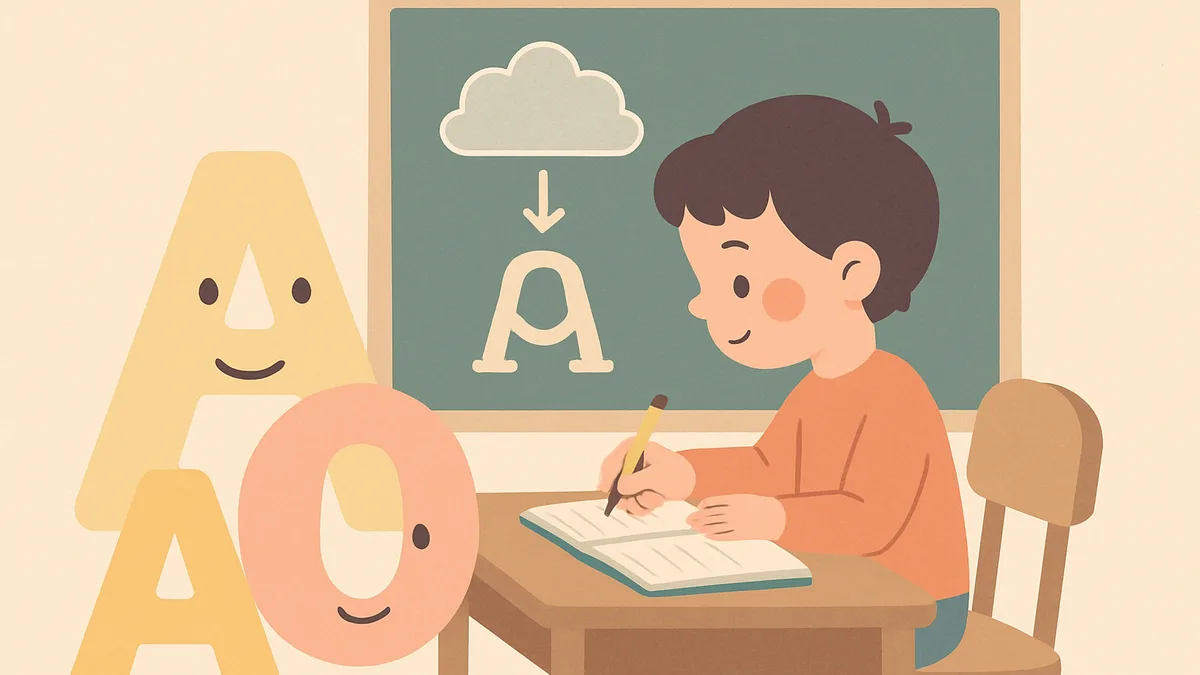
The one idea to carry through the whole lesson: a vowel does not decide its own sound. What comes after it decides. If a consonant follows the vowel inside the syllable, the sound is short. If nothing follows, the sound is long. Children who learn open and closed syllables stop guessing at long words and start predicting them.
Lesson at a glance
Who it is for: children who can already read short-vowel CVC words (cat, sit, bug) and are meeting two-syllable words. Usually Grade 1 (second half) through Grade 3, or any older reader who guesses at long words. Objective: the child sorts a syllable as open or closed and reads it with the matching vowel sound. Time: about 25 to 30 minutes for the first lesson, then 5-minute reviews over a week. Materials: index cards or a whiteboard, two marker colors, and our free Open vs Closed Syllables Cheat Sheet. Extra practice: phonics flashcards, the sound match game, and the CVC words list for review.
Open and closed syllables: why the difference matters
English spells the same vowel letter with different sounds, which looks chaotic until you notice a pattern. The letter a says one sound in nap and a different one in ba-con. The letter o says one sound in rob-in and another in ro-bot. The difference is not random. In each pair, the vowel is either shut in by a consonant or left standing at the end of its syllable.
This is why open and closed syllables are taught first among the six syllable types. They are 2 of the 6 syllable types in the full system (closed, open, vowel-silent-e, vowel team, r-controlled and consonant-le), and the rest build on this foundation. If you want the whole map, read our 6 syllable types guide; this lesson goes deep on the first two.
There is also a practical payoff for long words. A child who meets "cabin" for the first time has to choose a vowel sound for the first syllable before the word is known. A good decoder uses the syllable shape to make a smart first try and a quick correction if the try does not sound like a real word. That habit, a confident first guess followed by a flexible fix, is what this lesson is really building.
Warm-up (2 to 3 minutes): vowel sound check
Warm up the ears and the short vowel sounds before introducing anything new. Say each word and have the child show a closed fist if the vowel sounds short and an open hand if it sounds long. Use words without showing spelling at first.
- Say: cat, me, sun, go, bed, hi, dish, no. Child shows fist for cat, sun, bed, dish and open hand for me, go, hi, no.
- Then show the printed words and ask: what is the last letter of each word? Let the child notice that the fist words end in a consonant and the open-hand words end in a vowel. Do not explain yet; just let the observation sit.
If a child cannot hear short versus long vowels reliably, pause here and work on that first with our guide to long vowels vs short vowels. The rest of this lesson depends on it.
I do: teaching closed syllables with the door and the hand
Now model, using the metaphor of a door. Use your real hand as a prop: a fist for a shut door, a flat open palm for an open door. Say the words below as you do them. Keep your voice slow and calm and let the child just watch and listen.
Teacher script: closed syllables
"Look at this word: cat". There is one vowel, the letter a. After the vowel there is a consonant, t. The t is standing at the door. The door is closed, and the vowel is trapped inside. When a vowel is trapped, it says its short sound: /a/. Cat." Make a fist as you say "trapped". Then write nap, sit, bus and ask the child to point to the consonant at the door each time. Finish with: "A closed syllable has one vowel and ends in a consonant. The vowel says its short sound."
Note that several consonants can close the door. Stamp, lunch and crisp are all closed syllables: one vowel, then one or more consonants. The test is not how many consonants come after the vowel. The test is whether any consonant does.
I do: teaching open syllables
Teacher script: open syllables
"Now look at go". One vowel, the letter o. But look: nothing comes after it. The door is open. Nothing is holding the vowel in, so it can come all the way out and say its own name: /ō/, long o. Go." Open your palm as you say "come out". Repeat with me, he, hi, so, no, she. Then say: "An open syllable ends in a vowel. The vowel says its long sound, the same as its name."
Single-syllable open words are few, which is why most children meet this pattern first inside longer words. The ones to teach are the high-frequency ones: go, no, so, me, he, she, we, be, hi, and the y words my, by, fly, try, why. In these, the letter y is working as a vowel and says long i. Our post on y as a vowel explains when y is a vowel in more detail.
Closed versus open, side by side
Put both sets in front of the child and let them compare. Then use this table as your reference. Keep it visible during the whole lesson.
| Closed syllable | Open syllable | |
|---|---|---|
| Ends with | A consonant | A vowel (a, e, i, o, u, or y acting as a vowel) |
| Door picture | Door closed, vowel trapped | Door open, vowel free |
| Hand picture | Fist | Open palm |
| Vowel sound | Short | Long (says its name) |
| One-syllable examples | cat, sit, stamp, lunch | go, me, hi, she |
| In longer words | nap-kin, rab-bit, mag-net | ti-ger, ba-con, mu-sic |
We do: sorting syllables together (5 minutes)
Write twelve words on cards and sort them together into two piles under the headings "door closed" and "door open". Do the first four together out loud, then let the child take the lead while you ask questions instead of giving answers. Use words like: bed, go, trap, she, lunch, hi, frog, so, dish, we, stamp, no.
- Ask: "What is the last letter?" Then: "Vowel or consonant?" Then: "Is the door open or closed?" Then: "So which vowel sound?"
- Say the word after sorting it. The sort only helps if the sound follows the shape, so the child reads each card aloud once it lands in a pile.
- Correct with a question, not a verdict. If a card lands in the wrong pile, say: "Check the door. What is the last letter?"
Syllables inside longer words
Longer words are where the lesson earns its keep, and they come in two main shapes. When two consonants sit between two vowels (VCCV, such as nap-kin), the word usually divides between the consonants. When just one consonant sits between two vowels (VCV, such as ti-ger or rob-in), there are two possible places to divide, and that is the decision to teach carefully.
VC/CV words: two consonants, closed first syllable
Begin with the easy shape. Find the two vowels, put your finger under the two consonants between them, and divide between the consonants. The first syllable now ends in a consonant, so it is closed and the vowel is short. Read each part separately, then blend them: nap, kin; napkin.
Digraphs and blends stay together
Never split two letters that make one sound. Split dol-phin, not dolp-hin (ph is one sound), and do not break sh, ch, th, wh, ph or ck. Blends such as str, tr and bl also stay together at the start of a syllable, so in con-struct the division comes after the n and str is not torn apart.
The VCV rule: try open first, then closed
When a single consonant sits between two vowels, the word can divide in front of the consonant (V/CV) or after it (VC/V). English contains both, so no single rule can tell the reader in advance. The reliable method is a two-step try that works on the sound of the word, not the look of it. State it plainly and use the same words every time.
The VCV strategy: open first, then closed
Step 1: Divide before the consonant (V/CV). The first syllable is open, so try the long vowel: ti-ger. Step 2: If that does not make a real word, divide after the consonant (VC/V). The first syllable is now closed, so use the short vowel: rob-in. Say it in one line: "Try open first. If it is not a word, try closed."
Why open first? Treating the open reading as the first try is the standard approach in structured literacy programs, and it gives the child a clear, repeatable order to follow. The point is the flexibility, not the order. A child who tries open first and then corrects to closed will read both tiger and robin. A child who clings to the first reading will be stuck on one of them.
V/CV words: open first syllable, long vowel
Here the splits are ti-ger, ba-con, mu-sic, ho-tel, pi-lot, ro-bot, o-pen, pa-per, si-lent, spi-der, fe-ver, li-lac, ba-sin, e-ven, mo-ment, ba-by, to-tal, la-bel, ra-dar. The first syllable is open and the vowel is long. Notice the second syllable is usually closed: con, sic, tel, lot, bot, pen. (Paper, spider, fever and radar end in an r-controlled syllable.) Many words are an open syllable followed by a closed one, and the second syllable's vowel is often weak and quiet in speech, a schwa, as in the second part of bacon and silent.
VC/V words: closed first syllable, short vowel
These split after the consonant: rob-in, cab-in, lem-on, cam-el, sev-en, wag-on, hab-it, lim-it, pan-el, vis-it, mod-el, com-et, riv-er, cov-er, fin-ish, trav-el, mel-on, sal-ad, nev-er. The first syllable is closed, so the vowel is short. When a child tries the open reading first, the result is not a word: ca-bin, le-mon, ca-mel, se-ven, wa-gon, co-ver. That mismatch is exactly the signal to switch.
Worked example: robin versus tiger
Worked example: robin. A child sees r-o-b-i-n. Try open first: ro-bin, said like "ROH-bin". It is not a word they know, and it does not sound like the bird. Switch: rob-in, with the first syllable closed and a short o, said like "ROB-in". That is a real word, so the reading stands. Now try tiger the same way: ti-ger sounds right on the first try, so no switch is needed.
Pairs that look alike but divide differently
Contrast pairs build the habit of checking the sound against a real word. Practice these in twos, say each aloud, and have the child explain which door is open and which is closed.
| Word | Split | First syllable | Vowel sound |
|---|---|---|---|
| even | e-ven | open | long e |
| seven | sev-en | closed | short e |
| pilot | pi-lot | open | long i |
| limit | lim-it | closed | short i |
| music | mu-sic | open | long u |
| punish | pun-ish | closed | short u |
| hotel | ho-tel | open | long o |
| model | mod-el | closed | short o |
| paper | pa-per | open | long a |
| panel | pan-el | closed | short a |
When a closed syllable still sounds off
Some closed syllables do not give a perfect short vowel. In cov-er, the o is said like a short u ("cuv-er"), and in the unstressed syllables of lem-on or sev-en the vowel is a weak schwa. Teach the child to say the word with the nearest short sound and then ask, "Does that match a word I know?" Close counts, because the real word is recognised from context.
You do: guided practice (8 to 10 minutes)
Give the child a stack of index cards, each with one word from the lists above, and run the same four steps every time. Keep the cards in a small pile; do five at a time so the session stays short.
- Step 1: Look. Read the word silently. Put a finger under each vowel.
- Step 2: Divide. Draw a swoop or a slash. For two consonants between vowels, divide between them. For one consonant, divide before it first.
- Step 3: Name each syllable. Say "open" or "closed" for each part.
- Step 4: Read and check. Read the parts with the right vowel sounds, blend them, and ask, "Is that a real word?" If not, move the slash and try again.
For a child still learning to blend, practice reading each syllable on its own first. Our guide to how to teach blending shows how to make blending smooth. Once the child reads cards at a steady pace, move to nonsense syllables and short sentences: "The tiger sat on a cabin." Silly sentences keep real reading in the lesson without needing a decodable book.
Common errors and what to say
The same few mistakes show up again and again. This table lists each one and the exact response that works. In every case, point the child back to the door, not to a rule list.
| Error | What it sounds like | What to say or do |
|---|---|---|
| Reads an open syllable with a short vowel | ba-by read as "BAB-ee" (short a) | Point to the end of the first syllable. Say: "Nothing is at the door. What does the vowel say when it is free?" Have the child say the letter name. |
| Reads a closed syllable with a long vowel | nap-kin read as "nay-pkin" | Cover the end of the word. "What is closing the door? Then the vowel is trapped. Short sound." |
| Splits a digraph | dolp-hin instead of dol-phin | Teach digraphs as one unit. Circle ph and say: "These two letters make one sound; they never split." |
| Divides a VCV word the same way every time | Reads robin as ro-bin, cabin as ca-bin | Use the two-step: "Try open first. Is it a word? No? Try closed." Let the child move the slash. |
| Treats y as a consonant | Reads my with a short i, or baby with a hard y at the end | Say: "At the end of a syllable, y is a vowel. It says long i in my and long e in baby." |
| Counts vowel letters instead of vowel sounds | Says cake has two syllables because it has two vowel letters | Clap or tap the spoken word first. Count the beats, then find the vowel sound in each beat. |
| Over-applies the rule | Reads old, kind and most with a short vowel | Teach the small group of closed-syllable exceptions below as whole words. |
Exceptions worth teaching as whole words
Some closed syllables keep a long vowel. They are few and they have a pattern: the vowel is followed by two particular consonants in a cluster. Teach them as a small set, not as a flaw in the rule. Typical groups are -ild, -ind, -old, -olt and -ost (-ost is not reliable: cost, lost and frost are short).
There is also a group of words where a single vowel at the end of a one-syllable word is not long, such as the, to and do, which do not follow the pattern. These are irregular high-frequency words and should be taught as such. See our post on tricky words for a full list.
Is boat a closed syllable? Is stamp one?
Parents often ask this because the definition sounds simple but the examples are not. A closed syllable has exactly one vowel letter followed by at least one consonant, so stamp, lunch and crisp are all closed. Boat, though it ends in a consonant, has two vowel letters working together as a team (oa). That makes it a vowel team syllable, not a closed one. Likewise, bird has an r-controlled vowel and cake has a silent e. These are the other four syllable types; read about them in the 6 syllable types guide, vowel teams list, r-controlled vowels and magic e words.
Quick mastery check
Do this check after a few days of practice. Show one card at a time, ask the child to name the syllable type (open or closed) and read it aloud. These are nonsense syllables so the child cannot recall them from memory; they have to apply the rule.
| Card | Type | How it is read |
|---|---|---|
| mo | open | long o, said "moh" |
| mot | closed | short o, said "mot" as in hot |
| pe | open | long e, said "pee" |
| pef | closed | short e |
| ku | open | long u, said "koo" |
| kun | closed | short u |
| stri | open | long i, said "stry" |
| strib | closed | short i |
| fli | open | long i, said "fly" |
| flim | closed | short i |
Then show eight real words and ask the child to divide and read them: hotel (ho-tel), napkin (nap-kin), robin (rob-in), tiger (ti-ger), rabbit (rab-bit), lemon (lem-on), music (mu-sic), kitten (kit-ten).
- Mastered: at least 8 of 10 syllables correct and 7 of 8 words divided and read correctly, on two different days.
- Nearly there: correct naming but wrong vowel sounds. Go back to the hand and door warm-up and repeat for a few days.
- Not yet: cannot tell vowels from consonants at the end of a word. Return to short vowel CVC words and practice the vowel sounds before returning to this lesson.
A five-day plan to make it stick
| Day | Focus (about 10 minutes) |
|---|---|
| Day 1 | This lesson: door and hand, closed and open one-syllable words, sort cards. |
| Day 2 | VC/CV words: divide between consonants, read closed + closed words (napkin, rabbit). |
| Day 3 | V/CV words: open first syllable (tiger, bacon, music). Say the open-first rule aloud. |
| Day 4 | VC/V words and flexing: robin, cabin, lemon. Contrast pairs (even and seven). |
| Day 5 | Mastery check, then reading a short passage that contains two-syllable words. |
Short, repeated sessions work better than a single long one. If you want a ready structure for each session, our phonics lesson plan template shows how to fit this into a 20-minute lesson, and the free open and closed syllables cheat sheet makes a good reference on the table or fridge.
What comes next
Once open and closed syllables feel automatic, the next steps are the other four syllable types: vowel-silent-e, vowel team, r-controlled and consonant-le. Each one is a different way that the end of the syllable tells you the vowel sound. After that comes dividing words with prefixes and suffixes; start with prefixes and suffixes in phonics. Along the way, the sound-based games on our site, such as sound match, give extra practice without a worksheet.
Last, a note on expectations. The open and closed pattern is a reliable first guess, not a law. English has borrowed words, stress patterns that turn weak vowels into a schwa, and a handful of exceptions. The goal of this lesson is not a child who never needs to adjust. It is a child who makes a sensible first try, listens to whether it sounds like a word, and fixes it.
Free printable for this topic
Download the Open vs Closed Syllables Cheat Sheet and keep it next to the cards. It has the door picture and the VCV rule on one page.