
Tricky words by phase
Phase 1–2
intoPhase 3
whattheirpeoplePhase 4
dotodaysayswherewhoagainthoughtgreatprettyPhase 5
ohlookedcalledaskedwouldshouldbecausewateronceanymanyTop 25 by frequency
+ 7 more in the full list below
Free printable PDFs
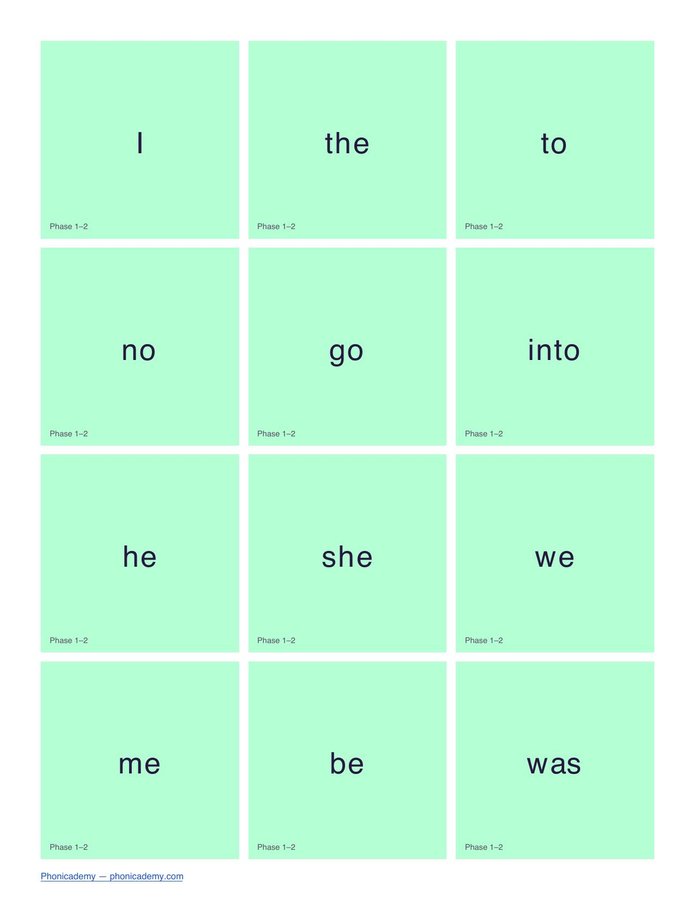
Tricky/Sight Words Flashcards by Phase
13 pages · 12 KB · PDF
All Phase 1–5 + high-frequency tricky words, color-coded by phase, 12-up flashcard layout — ready to cut and drill.
Download free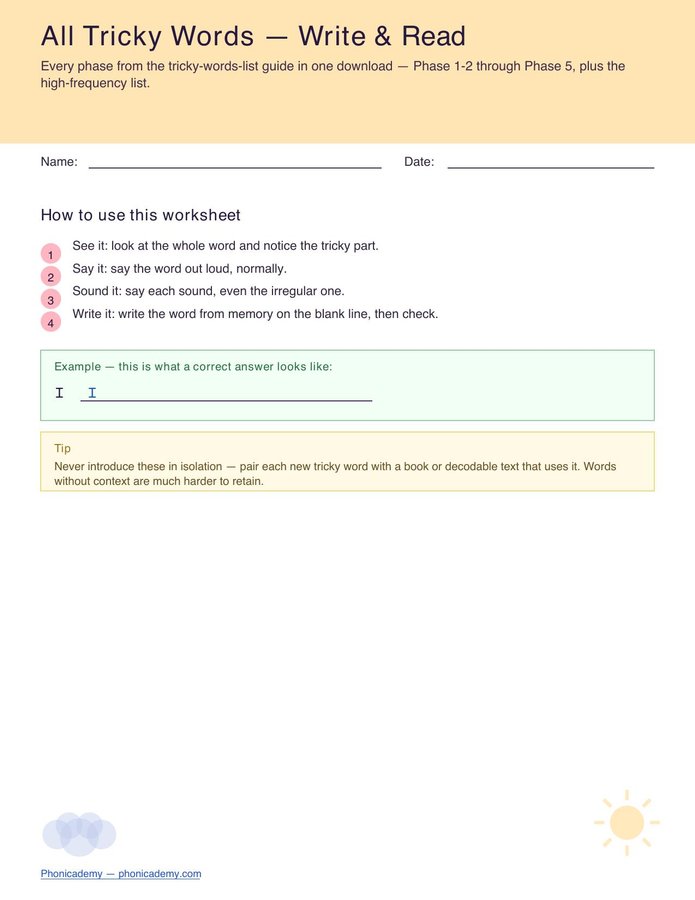
Tricky Words Worksheet — All Phases
7 pages · 20 KB · PDF
Every phase's tricky words in one printable, write & read.
Download free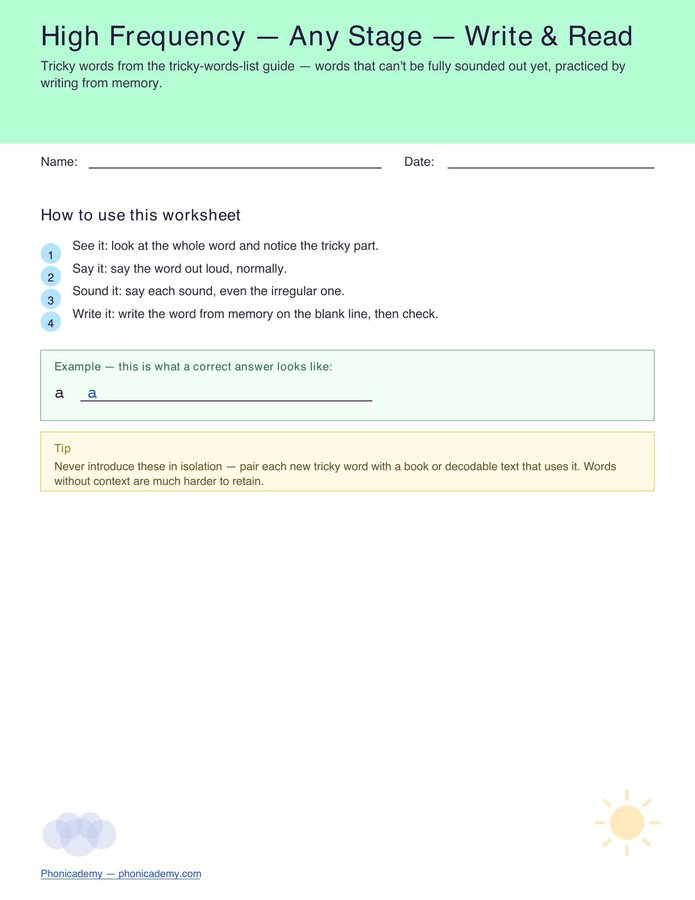
Tricky Words Worksheet — High Frequency
3 pages · 12 KB · PDF
The most common tricky/sight words, write & read.
Download free
No email needed for these three.
Practice it as a game
Tricky words (also called common exception words, sight words, or high-frequency words) are words that can’t be decoded using the phonics rules a child has learned yet. Some are irregular forever (like said— sounding it out gives you “sayed,” not “sed”). Others just contain phonics patterns the child hasn’t been taught yet.
Play it in your browser: Tricky Word Hunt →
This post gives you the full phase-by-phase list, explains why rote memorization alone doesn’t work, and gives you 5 techniques that actually stick.
Tricky words vs sight words — what’s the difference?
Tricky words (UK / Jolly Phonics term) = words that contain irregular or untaught patterns.
Sight words (US / Dolch / Fry term) = high-frequency words, both regular and irregular.
Most phonics programs introduce tricky words alongside phonics phases so children can read real books even before phonics is complete.
Why rote memorization doesn’t work alone
Flashcard drilling without phonetic analysis produces fragile memory. Brain imaging research (Dehaene, 2009) shows that fluent readers encode words in the visual word form area — but this area is only activated reliably when the word has been linked to its sound structure first.
The fix: before memorizing said, analyze it. “The s says /s/, the ai is the tricky part, the d says /d/. Say it: /s/ ... /ɛ/ ... /d/.” Then practice the word as a whole. This is the “see it, say it, sound it” method.
Tricky words by phase
5 techniques that make tricky words stick
1. See it, say it, sound it, write it
- See it: Look at the whole word. Notice the tricky part.
- Say it: Say the word aloud normally.
- Sound it:Say each phoneme, even if irregular. “said= /s/ /ɛ/ /d/ — the ai is tricky.”
- Write it: Write from memory, then check.
2. Highlight the tricky part
Write the word. Child uses a red pencil to underline the tricky letters. “s-ai-d — the aiis tricky because it says /ɛ/.” The act of marking encodes the exception.
3. Silly pronunciation
Temporarily pronounce the word the way it’s spelled. said = “SAY-d” when practicing spelling. The silly version provides a phonetic anchor. Once the spelling is automatic, the correct pronunciation takes over in reading.
4. Word detectives
Child looks for the tricky word in a picture book. Every time they find it, tap it and say it aloud. Encountering a word in context 10× builds faster automaticity than flashcard drilling.
5. Sky writing
Child writes the tricky word in the air with a large arm movement, says each letter aloud, then writes it on paper. Motor memory adds a second encoding channel — kids who use physical movement remember 40% more.
How many tricky words per week?
| Age | Words per week | Total by end of year |
|---|---|---|
| 4 (Reception/K) | 2–3 | 60–80 words |
| 5 (Year 1/Grade 1) | 3–4 | 100–120 words |
| 6 (Year 2/Grade 2) | 4–5 | 150–200 words |
Important: Never introduce tricky words in isolation from phonics. Each tricky word should come at the same time as a book or decodable text that uses it. Words without context are 3× harder to retain.
The most common tricky words ranked
The 25 most frequent words in children’s books — many are irregular:
These 25 words make up roughly 30% of all text in children’s books. Automating them is the single highest-leverage reading act a 5-year-old can perform.
Tricky words practice worksheets
The “see it, say it, sound it, write it” method above needs somewhere to write — these worksheets cover every phase, with a blank line under every word.
Download all 5 worksheets (149 words, Free PDF) — read each word out loud, then write it from memory on the line. No email required.
- Phase 1-2 worksheet — earliest readers (18 words, PDF)
- Phase 3 worksheet — learning digraphs (21 words, PDF)
- Phase 4 worksheet — CVC + blends (25 words, PDF)
- Phase 5 worksheet — vowel teams + split digraphs (25 words, PDF)
- High-frequency worksheet — any stage (60 words, PDF)
See sight words vs phonics for the debate on when to introduce tricky words, and the phonics stages by age guide for where tricky words fit in the overall sequence.