
Diphthong words: oi, oy, ou, ow
oi
oy
ou
ow
Free printable PDFs
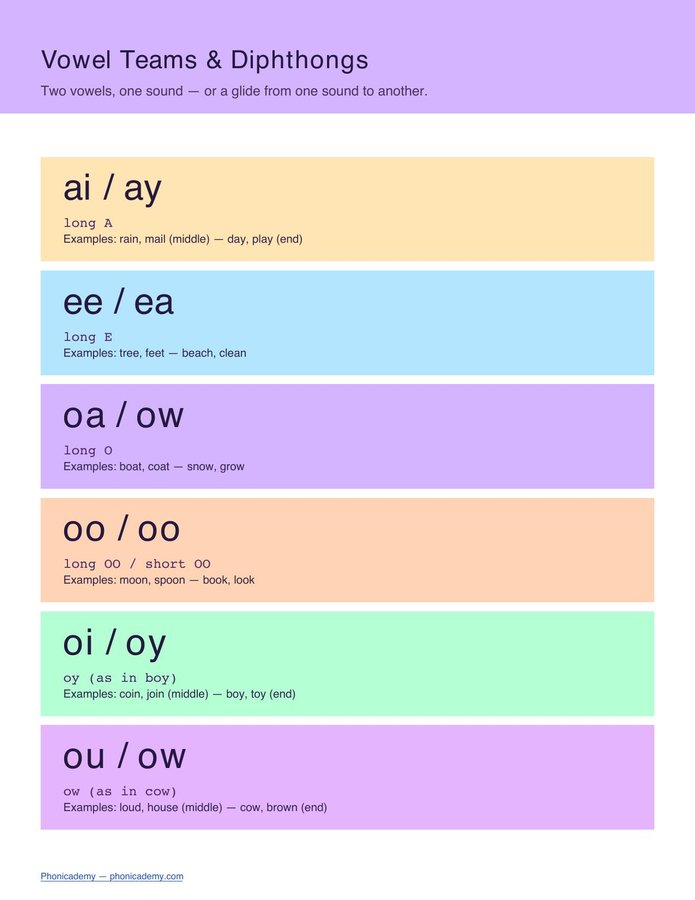
Vowel Teams & Diphthongs Cheat Sheet
1 pages · 4 KB · PDF
ai/ay, ee/ea, oa/ow, oo, oi/oy, ou/ow — position rules and example words for every long-vowel and diphthong spelling.
Download free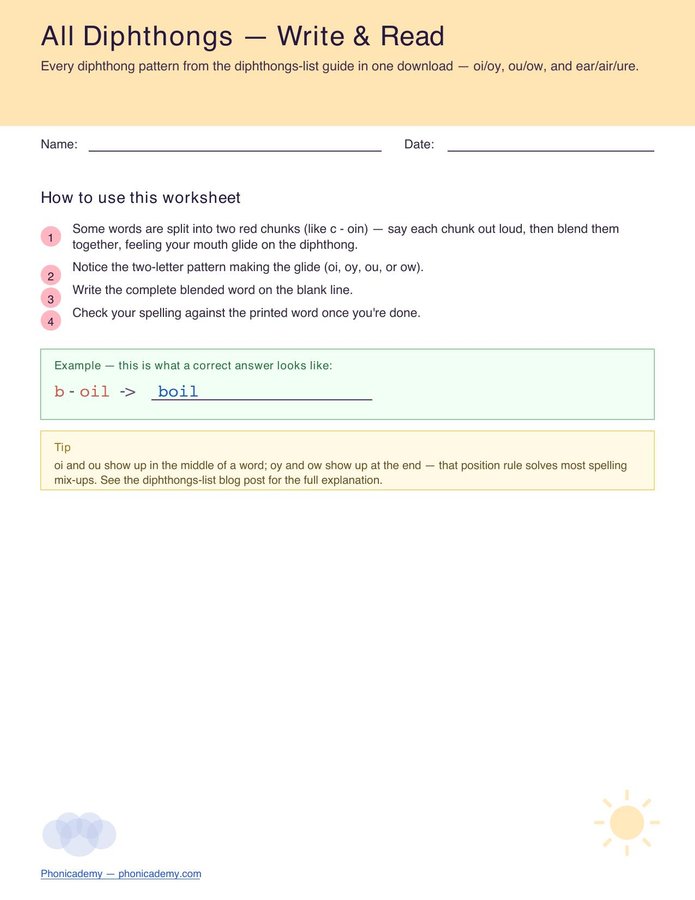
Diphthongs Worksheet — All Patterns
8 pages · 24 KB · PDF
Every diphthong pattern in one download — oi/oy, ou/ow, and r-patterns.
Download free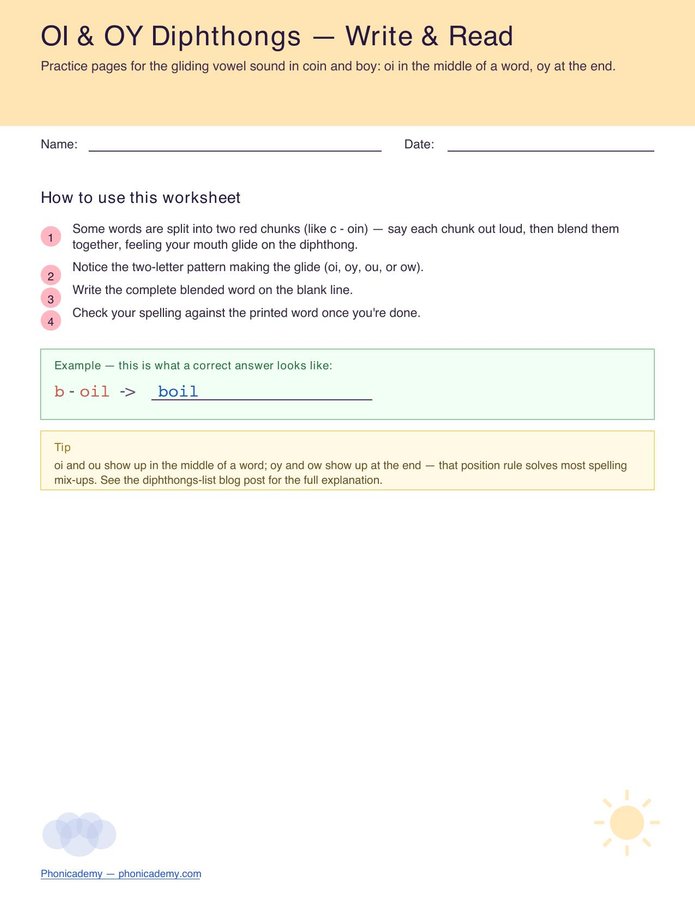
Diphthongs Worksheet — oi/oy
3 pages · 12 KB · PDF
Write & read practice for the oi and oy spellings.
Download free
No email needed for these three.
Practice it as a game
A diphthong is a vowel sound that starts in one position and glides to another within the same syllable. Your mouth actually moves while you say it. American English has 5 diphthongs — /aɪ/ (night), /aʊ/ (cow), /ɔɪ/ (coin), /eɪ/ (rain) and /oʊ/ (boat); British English counts 8, because it also glides in ear, air and ure. Phonics programs typically focus on the 4 most common spelling patterns: oi, oy, ou, ow.Here’s the full breakdown with word lists and teaching notes.
Play it in your browser: Vowel Team Pick →
Download the cheat sheet
Vowel Teams & Diphthongs Cheat Sheet (Free PDF) — one page covering oi, oy, ou, ow plus the vowel teams that come before them. No email required.
What makes diphthongs different
Long vowels hold a single steady sound. Diphthongs glide: coin starts at /ɔ/ and glides to /ɪ/; outstarts at /a/ and glides to /ʊ/. Kids who’ve learned to listen for steady vowel sounds sometimes miss the second part of a diphthong — or hear it as two separate sounds and try to spell it phonetically (“oi” → “oy” in a word ending).
OI — /ɔɪ/ in the middle of a word
The spelling oi appears in the middle of a syllable.
Word list:
OY — /ɔɪ/ at the end of a word or syllable
Use oy when the /ɔɪ/ sound comes at the end of a word or before a vowel suffix.
Word list:
Rule of thumb: ends the word → oy (boy, joy, toy). Middle of word → oi (coin, boil, voice). This rule works about 90% of the time.
OU — /aʊ/ in the middle of a word
The spelling oumakes the /aʊ/ diphthong sound in the middle of a syllable. (Note: ou also spells other sounds in “you,” “could,” “soup” — teach those as separate patterns.)
/aʊ/ word list:
OW — /aʊ/ at the end of a word
Use owfor /aʊ/ at the end of a word or before certain consonants (-n, -l). Note: ow also spells the long O sound in “snow, blow, flow” — a common confusion point.
/aʊ/ word list:
Disambiguation:“ow says /oʊ/ in snow and /aʊ/ in cow.” Teach both readings and have children try both when they see ow — context usually makes the right one obvious.
The other diphthongs
- /aɪ/ — long I: night, light, pie, tie, bike, kite, my, fly (see long vowels).
- /eɪ/ — long A: day, play, rain, cake.
- /oʊ/ — long O: boat, snow, toe, bone.
ear, air, ure: diphthongs in British English, r-controlled in American
British lists include three more glides — /ɪə/ (ear), /eə/ (air) and /ʊə/ (ure). In American English the r is pronounced, so these are taught as r-controlled vowels instead:
- /ɪr/ — ear spellings:
- /ɛr/ — air spellings:
- /jʊr/ — ure spellings: cure, pure, secure, manicure, curious (with a y sound). In sure, tour, poor there is no y sound, and many American speakers say them with /ʊr/ or /ɔr/.
When to teach diphthongs
Diphthongs come after long vowels (magic-e + common vowel teams) are secure — typically late Year 1 / mid-kindergarten in a well-paced program. The oi/oy and ou/ow pairs are the priority; the ear/air/ure patterns can follow in Year 2.
Common kid mistakes
- Spelling oi at the end of a word.“joy” → “joi.” Teach the position rule: end of word = oy.
- Confusing ow /oʊ/ and ow /aʊ/. Drill minimal pairs: blow/brow, low/cow, flow/fowl.
- Missing the glide.Reads “coin” as “con” or “coon.” Have them say the two parts slowly and join them.
Diphthong practice worksheets
Want your child to write each word too, not just read it? These worksheets cover every pattern above, with a blank line under every word.
Download all 3 worksheets (143 words, Free PDF) — read each word out loud, then write it on the line. No email required.
- OI & OY worksheet (49 words, PDF)
- OU & OW worksheet (55 words, PDF)
- EAR, AIR & URE worksheet (39 words, PDF)
The phoneme map includes audio for all diphthongs — use it so your child can hear the glide before practicing in words.
The ear/air/ure patterns above are r-controlled vowels — part of the first-grade phonics skill set. If this stage is taking longer than expected, our guide to how long phonics actually takes covers what’s normal variation.