
I before e except after c is the best-known spelling rhyme in English, and it is also one of the least reliable. It works for one narrow job, the long /ee/ sound, and breaks the moment a word steps outside it. This guide gives you the full version of the rule, where it came from, why it fails, a sorted list of the exceptions, a simpler rule children can actually use, and a 10-minute lesson with the exact words to say.
It is written for parents, homeschoolers and K–5 teachers. You do not need a linguistics background. If you can say a word aloud and listen for its sound, you can run everything below.
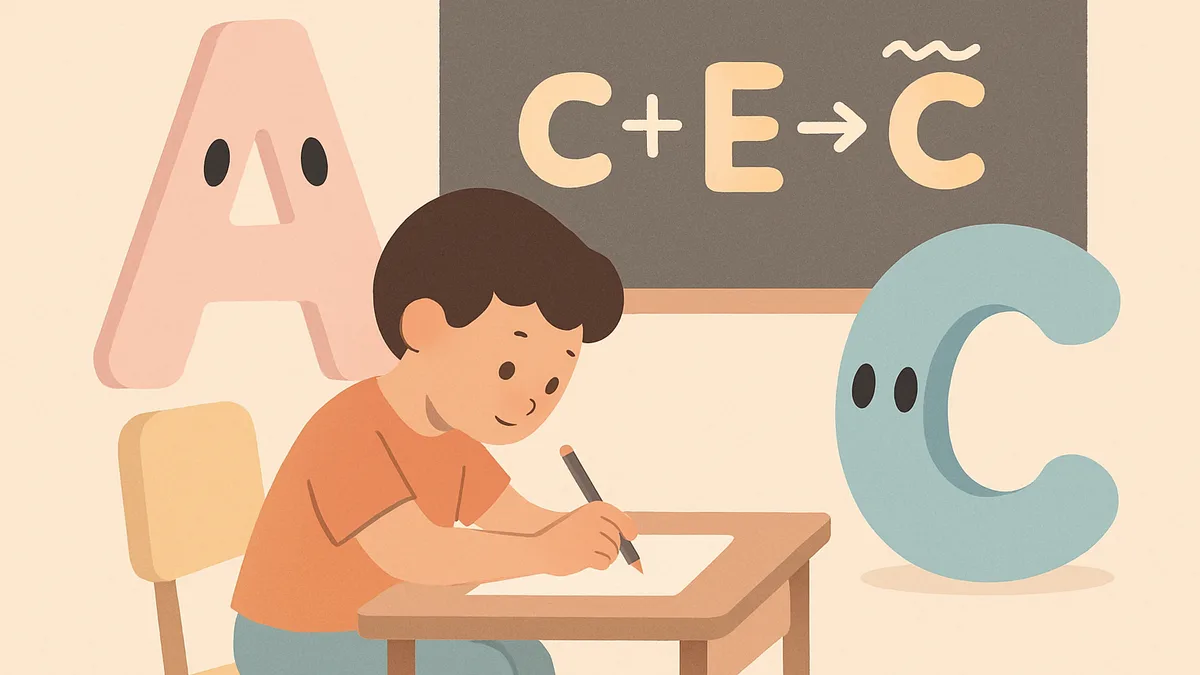
I before e except after c: the full rule
The short rhyme most of us learned is only the first half. The fuller version reads: i before e, except after c, or when sounding like a, as in neighbor and weigh. Read carefully, it hides a condition that the short version drops. The rule is about a sound, not about the letters i and e wherever they meet.
- Case 1, i before e: when the vowel pair says long /ee/ and no c comes right before it. Examples: believe, field, chief, piece, thief, niece.
- Case 2, except after c: when the pair says /ee/ and a c comes right before it, flip to ei. Examples: receive, deceive, ceiling, receipt, conceit.
- Case 3, or sounding like a: when the pair says long /ay/, spell it ei. Examples: eight, weigh, neighbor, vein, reign, freight.
The one thing to remember
The rule only applies when the pair says /ee/ (or /ay/ in the long version). If a word has ie or ei but makes a different sound, the rhyme says nothing about it. Most of the so-called exceptions are in this group.
Where the rule comes from
Spelling rhymes like this one grew out of classroom teaching. Printed spelling guides in English-speaking countries have carried versions of the "i before e" couplet for well over a century, and generations of teachers have passed it on because it is short, rhythmic and easy to chant. The reason it exists is real. English borrowed many words from French and Latin, and in a good number of them the /ee/ sound was written ie (chief, relief, siege). A smaller set, mostly built on the Latin root meaning "to take" (receive, conceive, perceive, deceive), kept ei after c. Teachers noticed the pattern and wrapped it in a rhyme.
The rhyme is a memory aid, not a law of the language. Spelling in English reflects where each word came from, not a single tidy system, so any rule this short is bound to leak. That does not make it useless. It makes it a starting guess, and the skill to teach is knowing when the guess applies.
Why the rule fails so often
Three problems explain nearly every complaint about the rhyme. Once a child understands them, the rule stops feeling random.
- It ignores the sound. Many people apply it to every ie or ei, but science, height, foreign and friend do not have the /ee/ sound, so the rule never covered them.
- It covers only the /ee/ and /ay/ sounds. English has other sounds for the same letter pairs: ie can say long i (pie, tie), short e (friend), or the /sh/-plus-vowel sound after c (ancient, efficient). Ei can say long i (height), /air/ (their, heir) or a weak vowel (foreign).
- It has true exceptions even inside its own territory. Some words do say /ee/, have no c, and still use ei: seize, weird, either, neither, protein, caffeine. A few say /ee/ after c and still use ie: species.
Researchers who have counted spellings across large word lists have found that the rhyme has many exceptions, and that the number grows when you apply it to every ie and ei instead of only the /ee/ words. We will not put a percentage on it, because the answer depends on which list you count and how you treat words like science. What matters for teaching is the practical conclusion: the rule is useful for the /ee/ sound, and weak anywhere else.
The exceptions list, sorted by cause
A flat list of exceptions is hard to learn. Sorted by the reason each word breaks the pattern, it becomes a handful of small groups. Use the table below as a reference, then look at the word lists that follow.
| Group | What is happening | Example words |
|---|---|---|
| ei says /ee/, no c before it | True exceptions to the main rule. Learn by sight. | seize, weird, either, neither, protein, caffeine, codeine, leisure |
| ie says /ee/ after c | True exceptions to the after-c rule. | species |
| cie says /sh/ plus a vowel | The c is a soft /sh/ sound, so the /ee/ rule does not apply. | ancient, efficient, sufficient, deficient, proficient, glacier |
| ei says long /ay/ | Covered by the long version of the rhyme. | eight, vein, reign, freight, sleigh, beige |
| ei says long i | Not /ee/, so not covered by the rhyme. | height, heist, feisty, kaleidoscope, sleight |
| ei says /air/ or a weak vowel | Not /ee/, so not covered by the rhyme. | their, heir, foreign, forfeit, counterfeit, sovereign |
| ie says short e or long i | Not /ee/, so not covered by the rhyme. | friend, pie, tie, lie, die, fiery |
| ie after c in plurals and verb forms | The y at the end of the base word changed to i, then es was added. See the change y to i rule. | fancies, policies, agencies |
Watch out for the cie group
Science, ancient, efficient and sufficient look like they break the "except after c" half of the rhyme, because ie follows c. They do not, because that half only governs the /ee/ sound. Species is different: it has an /ee/ after c and still uses ie, so it is a true exception. A child who learns these as two separate groups will be much less confused.
The plural and verb-form trap
Words like fancies, policies and agencies contain c followed by ie. They are not exceptions to the rhyme at all. They come from a base word that ends in cy (fancy, policy, agency), where the y changes to i before es is added. The ie that appears is the ending, not a vowel pair inside the word. Teaching this connection saves a child from adding these words to the "weird exceptions" pile. If your child is working on these patterns, see our guides to the change y to i rule and plural spelling rules.
A better rule children can use
Instead of asking a child to memorize the rhyme and its long list of exceptions, teach a short decision routine. It starts with listening, which is where English spelling decisions should start.
- Step 1, listen. If the word has ie or ei, say it slowly. Do you hear /ee/ (like bee), /ay/ (like day), or something else? If it is something else, the rhyme does not apply. Stop and use your best knowledge of the word.
- Step 2, look for c. If you hear /ee/, is there a c right before the spot? If yes, write ei (receive, ceiling). If no, write ie (believe, field).
- Step 3, check for /ay/. If you hear /ay/, write ei (eight, vein, weigh).
- Step 4, check the short list. If a word says /ee/ with no c but is on the small list of sight words (seize, weird, either, neither, protein, caffeine), use ei. Species and plurals of words ending in cy (policies, agencies) keep ie after c.
The routine has one great advantage. It never asks a child to guess the rule's reach. Listening comes first, and the exception list is short and sortable. The four steps together handle most ie/ei words children meet through Grade 5.
A sentence children remember
Try a silly sentence: Neither weird sheik could seize the caffeine. It is silly on purpose and packs several of the awkward ei spellings into one line. Children enjoy it, and silly sentences are often easier to recall than a list.
Teach it in 10 minutes: a sort-by-ear lesson
Who it is for: Grades 2–5, one child or a small group. Objective: the child sorts ie and ei words by sound first, then spells them with the four-step routine. Time: about 10 minutes. Materials: 12 to 16 word cards, three sorting mats labelled /ee/, /ay/ and other, and a pencil. You can make cards from the lists in this post or print our I Before E Cheat Sheet.
Warm-up (2 minutes)
Say each word and ask the child to tell you the vowel sound before showing any letters. Teacher words: "Listen to this word: chief. What vowel sound do you hear in the middle? Say it with me: /ee/. Now neighbor. What do you hear? /ay/. Good. We are going to listen first and spell second."
I do (2 minutes)
Model with two words. Teacher words: "Watch me. The word is receive. I say it slowly: re-ceive. I hear /ee/ after a /s/ sound made by the letter c. The letter c comes right before the /ee/. My rule says after c, e before i. I write r-e-c-e-i-v-e." Then model believe: "I hear /ee/. There is no c before it. So I write i before e: b-e-l-i-e-v-e."
We do (3 minutes)
Hand over the cards one at a time. Read the word, ask the child to tell you the sound, and place the card on the mat together. Teacher words: "Let's sort. Fierce: what sound? /ee/. Is there a c? No. So the spelling is ie. Ceiling: /ee/. Is there a c? Yes. So ei. Eight: /ay/. That is ei when the word has ie or ei." Place words like height and friend on the other mat and say: "These have ie or ei, but the sound is not /ee/ or /ay/, so our rhyme does not help. We learn these by sight."
You do (3 minutes)
Say five words from the grade list below and have the child write each one. For each word the child should say the sound aloud before writing. Praise the routine, not only the final spelling: "I like how you listened for the sound first."
Word lists by grade
| Grade | Words to teach | Why this order |
|---|---|---|
| Grade 2 | field, chief, piece, thief, brief, eight, neighbor, friend | Mostly common /ee/ and /ay/ words the child already reads. Friend is taught as a sight word. |
| Grade 3 | believe, niece, yield, shield, ceiling, receive, receipt, weigh, vein, reign, height, their | Adds the after-c pair and the first exceptions. |
| Grade 4 | achieve, relief, siege, deceive, conceive, perceive, either, neither, weird, seize, science | Adds the true exceptions and the first cie word. |
| Grade 5 | protein, caffeine, leisure, species, ancient, efficient, sufficient, foreign, sovereign, forfeit, counterfeit | Low-frequency words and the cie group. Use them for review and for older strugglers. |
Common spelling errors and how to correct each
Most mistakes come from guessing the vowel order without listening to the sound. Correct the reasoning, not just the letters. Say what is wrong and give the child the question to ask, so the next word goes better.
| Child writes | Correct spelling | What to say |
|---|---|---|
| recieve | receive | "Listen: /ee/ right after c. After c we flip to e before i. Fix the order." |
| beleive | believe | "/ee/ with no c before it. That is ie. Try i before e." |
| wierd | weird | "This one breaks the rhyme. It says /ee/ with no c and still uses ei. Weird is on our sight-word list." |
| sieze | seize | "Another sight word. Say it: /seez/. No c, but ei." |
| thier | their | "This word says /air/, not /ee/, so the rhyme does not help. Their is a sight word: ei." |
| freind | friend | "Listen: /e/ as in bend. Not /ee/. Friend is a sight word: ie, as in fri + end." |
| sceince | science | "The c says /s/ and the ie is two sounds, not /ee/. The rhyme is not for this word. Learn it in chunks: sci-ence." |
| hieght | height | "Height says long i. Not /ee/. It is spelled like eight with an h in front: h + eight." |
| nieghbor | neighbor | "/ay/ spelling is ei. Think: ei, ay, eight, weigh, neighbor." |
| speceis | species | "A true exception. Species has /ee/ after c but uses ie. Say it in syllables: spe-cies." |
Related word lists for practice
Once the main routine works, a little extra practice makes it stick. Read each word aloud, say the vowel sound, then spell.
- More ie words (/ee/, no c): grief, relief, achieve, shield, siege, priest, fierce, pierce, retrieve, yield.
- More ei words after c (/ee/): perceive, conceit, deceit, receipt, ceiling, conceive.
- More ei words for /ay/: eighty, veil, reign, feign, beige, weight, eighteen, reindeer, sleigh.
- True exceptions to memorize: leisure, codeine, seize, weird, protein, caffeine, either, neither, species.
A quick way to practice at home
Write each word on a card. Have your child sort it into one of the three mats (/ee/, /ay/, other) before checking the spelling. Sorting by ear first is the whole point of the routine. Our free flashcards are a handy way to build a custom deck, and the cheat sheet printable keeps the four steps in one place.
How to check mastery
A child has learned the routine when they can do three things without help: sort words by sound, explain why a spelling is ei or ie, and spell the sight-word exceptions correctly in their own writing. A short check you can run in five minutes:
- Read these 10 words aloud, one at a time. The child says the vowel sound before writing: field, receive, eight, weird, ceiling, friend, niece, neighbor, seize, height.
- Score each word for the spelling and for the explanation. The routine matters as much as the final answer.
- Look at the child's recent free writing. Any recurring misspelling (recieve, wierd) points to the group to re-teach.
- Re-test two weeks later with five new words (relief, deceive, vein, neither, science). Retention after a gap is the real test.
Answer key: field, receive, eight, weird, ceiling, friend, niece, neighbor, seize, height. A child who gets 9 of 10 right with the correct explanation is ready to move on. A child who gets 7–8 needs only the groups they missed re-taught. A child who gets fewer than 7 needs the sort-by-ear lesson repeated over several days with fewer words each time.
What to do next
The i before e rhyme is one of many spelling patterns that depend on the sound heard in the word. For the big picture, read our guide to English spelling rules. For vowel pairs that make long sounds, see the vowel teams list. If your child struggles with c saying /s/ or /k/, the hard c and soft c rule will help. To link spelling changes at the end of words, read suffix spelling rules and the drop the e rule. Silent and odd letters show up in silent letters list.
Free printable for this topic
Download the I Before E Cheat Sheet - a free PDF you can print and use today.