
You'll see "the 5 pillars of reading" mentioned on curriculum websites, in teacher training, and in school newsletters, usually without much explanation. They're not a brand or a program — they're a simple way of grouping the skills that decades of reading research keep pointing to as essential. Here's what each one actually means.
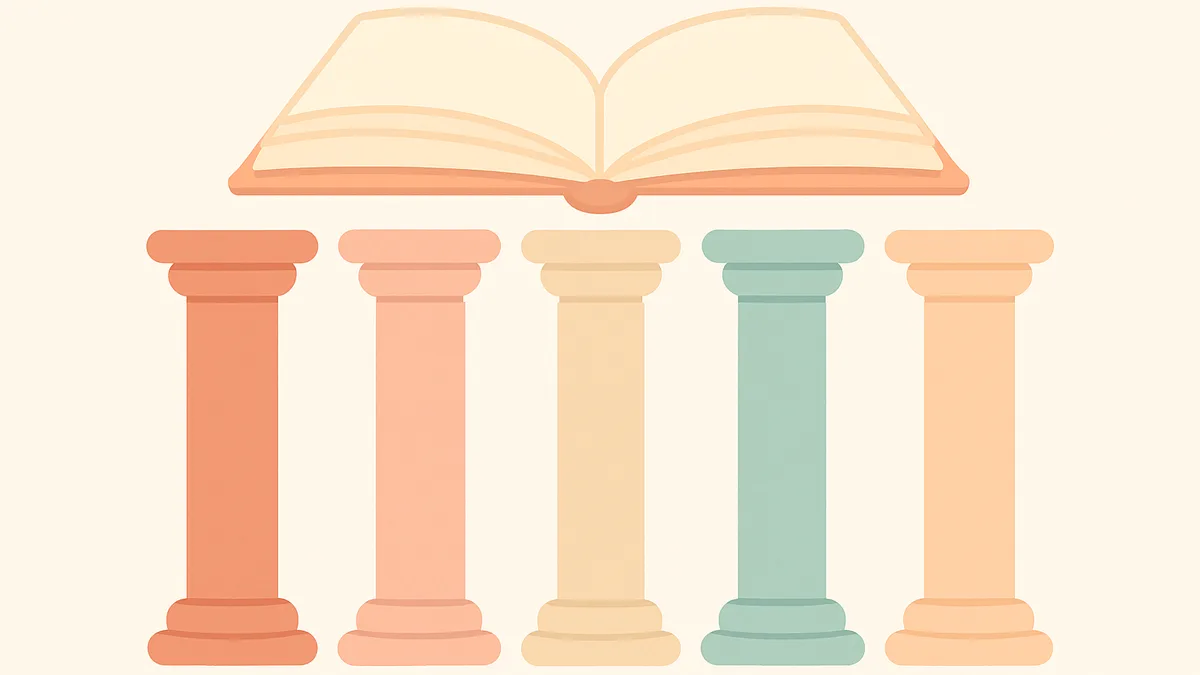
Where the framework comes from
In the early 2000s, a large U.S. government-commissioned review pulled together decades of reading research and grouped the strongest, most consistent findings into five components. The grouping stuck because it's genuinely useful: it gives teachers and parents a shared vocabulary for talking about which specific skill a child might be struggling with, instead of a vague sense that "reading isn't clicking."
The five pillars, in plain English
- Phonemic awareness — hearing and manipulating the individual sounds in spoken words, without any letters involved (knowing that "cat" is made of three sounds, /k/ /a/ /t/, is done entirely by ear).
- Phonics — connecting those sounds to written letters and letter patterns, so a child can sound out ("decode") words they've never seen in print before.
- Fluency — reading text accurately, at a reasonable pace, and with natural expression, so decoding stops taking up so much mental effort that meaning gets lost.
- Vocabulary — knowing what words mean. A child can decode a word perfectly and still not understand a sentence if the words themselves are unfamiliar.
- Comprehension — the actual goal of reading: building meaning from a sentence, a paragraph, a whole text — including inference, not just literal recall.
They're not five separate stages
It's tempting to picture these as a ladder you climb one rung at a time, but they develop in parallel and keep reinforcing each other well past the early grades. A child is still building vocabulary and comprehension skills for years after decoding becomes automatic.
Why phonics and phonemic awareness get the most attention
All five pillars matter, but phonemic awareness and phonics get singled out in most Science-of-Reading discussions because they're the pillars most reliably fixed by direct, explicit teaching — and the ones most likely to quietly break down without anyone noticing, since a child can often mask a phonics gap by guessing from pictures or context for a surprisingly long time. Vocabulary and comprehension, by contrast, tend to grow steadily just from being read to and talked with, on top of formal instruction.
How the pillars fit together
If you want a model of how these pieces combine into actual reading skill, the Simple View of Reading boils it down to two big factors (decoding and language comprehension), while Scarborough's Reading Rope shows how the sub-skills underneath each pillar braid together over years, not months.
For the full picture of what current reading research recommends and why, see our Science of Reading overview. And if the phonemic-awareness/phonics distinction above wasn't fully clear, our phonemic awareness vs phonics comparison walks through it side by side.
Not sure where to start?
Build a free personalised phonics practice plan for your child — pick a start date and pace, we schedule the rest.